TRANSITIONS – Informal Transport Compendium Report
Published: {acf_publication_date: F Y}
Main topic: Access and infrastructure, Public transport
Study countrie(s): South Africa, Sierra Leone, Mozambique, Ghana, Zimbabwe
Written by: Roger Behrens, Simon Saddier, Tatenda Mbara, Tim Durant, Laurie Pickup, Braima Koroma, Charles Adams, Herrie Schalekamp, JoaquÃn Romero de Tejada, Joseph Macarthy, Marion Hoyez, Mark Zuidgeest
Published by: J Turner Transport and Social Development Consultancy, GoteoMoz, Kwame Nkrumah University of Science and Technology (KNUST), Sierra Leone Urban Research Centre (SLURC), Tatenda Mbara, Transitec, University of Cape Town, Vectos
Study type: Research report
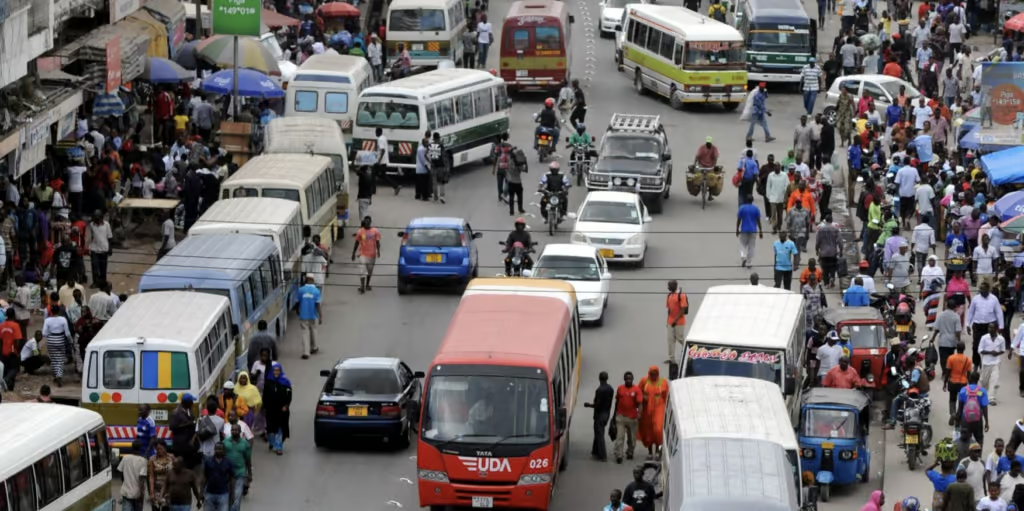
Aim – The purpose of this report is to review the state of knowledge in the field of informal public transport in Sub-Saharan African cities, and to identify important gaps in knowledge from the perspective of formulating policy interventions with prospects for delivering low carbon, affordable and safe mass transport.
Method – The scope of the review was limited to informal transport vehicles providing public transport services, commonly in the form of minibuses. The literature search used database keywords, backward snowballing, and prominent author searches, in relation to nine topics and six cities (Accra, Cape Town, Freetown, Harare, Kumasi and Maputo), and yielded 386 publications.
Findings – From the review of these publications, it is clear that the informal transport industry is complex, heterogeneous, and multi-sectoral in nature. Fierce ‘in the market’ competition for passengers, and the cash nature of businesses, creates problems for employment conditions, service quality, fleet renewal, and environmental impact. But the sector also offers real benefits and competitive value. Policy interventions to improve operating environments for informal transport vehicles have been relatively few, with most focussed on replacing them with formal mass transit. Encouragingly though, in some cities at least, policy positions have shifted from replacement to integration and upgrade.
A feature of the current body of knowledge is its geographical unevenness. There are parts of the subcontinent about which no publications were found, and there are inherent dangers in assuming contexts, operating practices, problems, and institutional capacities are similar. Therefore, in some cities, greater depth of understanding is required, while in others, the basic features of the sector still need to be described.
Greater knowledge is required on the scale and nature of informal operations and businesses, vehicle acquisition practices, the political economies and governance contexts within which policy interventions occur, and the outcomes and lessons from past interventions.
Conclusion – The complex, heterogeneous and multi-sectoral nature of the industry has meant that attempts to introduce changes in practice or new technologies, that move the industry onto a more efficient, safe, and lower carbon path, have proven difficult to implement at scale. There are no transferable panacea solutions from within or outside the sub-continent. Grounded solutions are required, and in this regard the recent growth in research activity observed in the review (more than half of the publications were published within the past five years) is welcome.