T-TRIID Final Report – Low carbon Hyderabad bus fleets
Published: {acf_publication_date: F Y}
Main topic: Climate change
Study countrie(s): India
Written by: Phil Davies
Published by: Water Fuel Engineering Ltd.
Study type: Research report
To tackle the issue of rising greenhouse gas (GHG) emissions in developing countries, the UK Department for International Development (DFID) launched the Transport-Technology Research Innovation for International Development (T-TRIID) under the High Volume Transport Applied Research Programme.
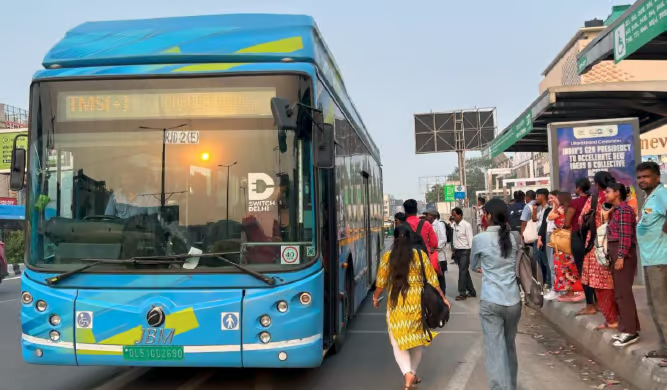
The Low Carbon Hyderabad Bus Fleets project was a six-month research project undertaken from October 2018 to March 2019, led by Water Fuel Engineering (WFE) in collaboration with Telangana State Road Transport Corporation (TSRTC) based in Hyderabad, India. The aim of the project was to reduce the tail-pipe emissions of twenty-year old public transport buses. TSRTC has one of the largest bus fleet in the world, consisting of 10,525 vehicles.
WFE is a company striving to create a cleaner and more efficient use of energy in the future. Established in 2013, WFE specialises in the research and development of alkaline electrolysers which can be used commercially, domestically or industrially to improve the combustion efficiency of conventional fuels.
The HydroGen™ is an autonomous electrolyser that is powered by an alternator, using an average of 6 to 12 amps. By splitting water (H2O) into its two component gases, this unique system delivers an amalgamated gaseous mixture of hydrogen and oxygen to any engine via the air intake to accelerate the combustion speed of carbon-based fuels. The result is more energy being released and lower levels of polluting emissions, soot and particulates being produced when using fuels such as diesel or petrol.
Thanks to the T-TRIID grant, WFE has been able to successfully complete road trials in India in collaboration with the Telangana State Road Corporation. The retrofitting of oxyhydrogen electrolysers to six buses, aimed to demonstrate the ways in which this technology can reduce emissions on older, conventional diesel vehicles. In low income countries (LICs), alternative fuels and comprehensive fleet upgrades are unaffordable. Developed countries too are struggling to identify alternatives to diesel for heavy duty usage.
The project exposed WFE to the challenges of exporting, customs clearance, excise duties and documentation. The geography (working 5,000 miles from our base), climate (working in temperatures of up to 35C), culture (working with partners of a different mind-set), each added to the challenges. However, WFE staff were enriched and empowered by the experience, rendering the company as a whole, better equipped to take this project to the next stage.
Although the project was conducted exclusively in Telangana State, WFE were mindful of DFIDs objectives to reach out to all LICs in the pursuit of improved air quality. Consequently, partners across India have been identified and collaborations in Jordan and Sri Lanka have also commenced in principle. As this report will demonstrate, scaling up to reach out to all LICs is entirely possible.
The project in Telangana has attracted the support of Indian investment company, Tavasya Venture; with the promise of investment and support. Initial discussions with their Head of Business Development has resulted in a Letter of Intent. (Appendix 2).
The momentum generated by this project and the support received from T-TRIID (and from Gary Haq in particular), has enabled WFE to both deliver on and exceed expectations as laid out in the DFID guidelines.
Moreover, the results of the trials themselves have validated the theories behind the technology and established the effectiveness of retrofit electrolysers in matching emissions in the laboratory (80%), with emissions reductions in real-world conditions (75.4%).
Although two of the units malfunctioned, the lessons learned will enable further improvements to be made to the systems. Challenges due to the extreme weather conditions in India had been anticipated, however the trial revealed several additional weaknesses in the systems that can now be corrected; modifications that will deliver reliable, market-ready units for countries throughout the world.
The four units that completed the trials delivered consistent emissions reductions averaging 75.4%; Just 4.6% below target levels that had been reached in laboratory conditions. The two dimensions to the emissions tests (HSU ‘opacity’ and kVal – ‘mean’ value calculation), again provided evidence of the integrity of the analysis by delivering comparable data within 3 percentage points of each other. The emissions testing was undertaken independently by a Government of India inspection team and certified accordingly.
Fuel consumption was monitored by TSRTC, who reported no significant savings. Whilst this was disappointing, it is most likely reflected by the anomalies within the TSRTC processes themselves which were manually undertaken and loosely recorded. Variations in driver performance accounted for variations in fuel consumption of 65.1%, so identifying savings of 10% would always be a challenge. However, unlike emissions analysis, fuel efficiencies are easily monitored and verified, and we stand by the results obtained elsewhere which have never fallen below 8% improvement levels.
With emissions results established along with the interest of funding partners in India, the potential for the WFE electrolyser across LICs is immense.