POLICY BRIEF: How has the mobility of vulnerable people been impacted by COVID-19
Published: {acf_publication_date: F Y}
Main topic: Climate change, COVID-19
Study countrie(s): Zambia, Bangladesh, Pakistan, Tanzania
Written by: M. Shafiq-Ur Rahman
Published by: M. Shafiq-Ur Rahman
Study type: Policy note
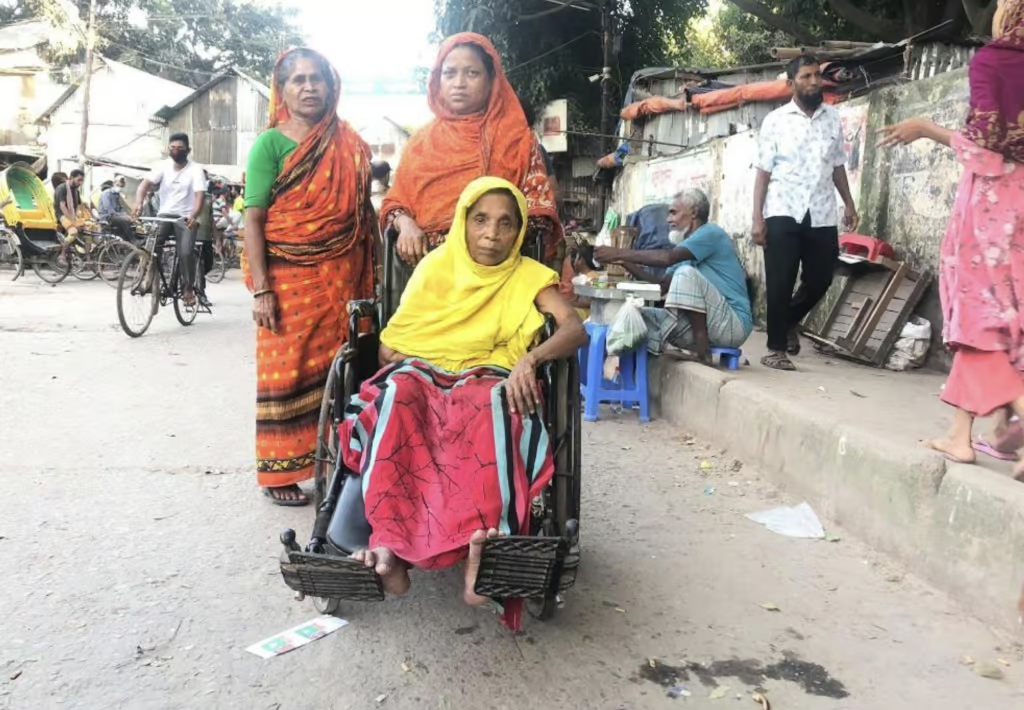
Elderly and physically challenged people have different travel needs and challenges. Transport infrastructure and services in all Low-Income Countries (LICs) are not easily accessible for elderly and physically challenged people. Added to these problems, the Novel Coronavirus Disease 2019 (COVID-19) pandemic has had a profound impact on peoples’ mobility in almost every country around the world (i.e. both in LICs and elsewhere), changing activity patterns and travel behaviour.
This research provides a detailed understanding about the mobility of elderly and physically challenged people in LICs during COVID-19; particularly as to whether there are any significant changes due to COVID-19 and any major constraints or issues related to their travel. Household surveys of 1,669 elderly and physically challenged people were conducted in eight case study cities in Bangladesh, Pakistan, Tanzania and Zambia during November 2020.
It was found that public transport services in the case study cities are very poor and lack appropriate infrastructure to facilitate mobility of elderly and physically challenged people even before COVID-19 pandemic. Therefore, elderly and physically challenged people in LICs often face many difficulties for travel. Moreover, their travel in all the cities has changed due to COVID-19 and they face even more problems that previously. The most significant changes and problems were found to be: reduction of travel; changed travel mode such as switching from public transport to private and non-motorised modes; increased travel cost and decreased income; and additional travel problems such as the need to maintain physical distancing and the need to use masks and hand sanitizers.
Based on the results of this research, the suggested policy options are to: improve infrastructure for nonmotorised modes and promote sustainable modes of the city; provide transport infrastructure and services that are accessible for elderly and physically challenged people; subsidise the travel costs of elderly and physically challenged people particularly during COVID-19; plan and regulate informal modes or para-transits; increase the number of public transport vehicles and routes; and generate public awareness concerning health guidelines, followed by strong enforcement of physical distancing, wearing face masks, and using sanitisation during travel. The findings will be helpful for city authorities in making appropriate policy decisions, formulating strategies and investment plans related to transport, as well as in supporting COVID-19 responses and recovery plans.