Investing in Walking in African Cities: Moving Beyond Policy
Published: {acf_publication_date: F Y}
Main topic: Access and infrastructure, Climate change, Adaptation, Walking
Study countrie(s): Africa
Written by: Walk21 Foundation
Study type: Research report
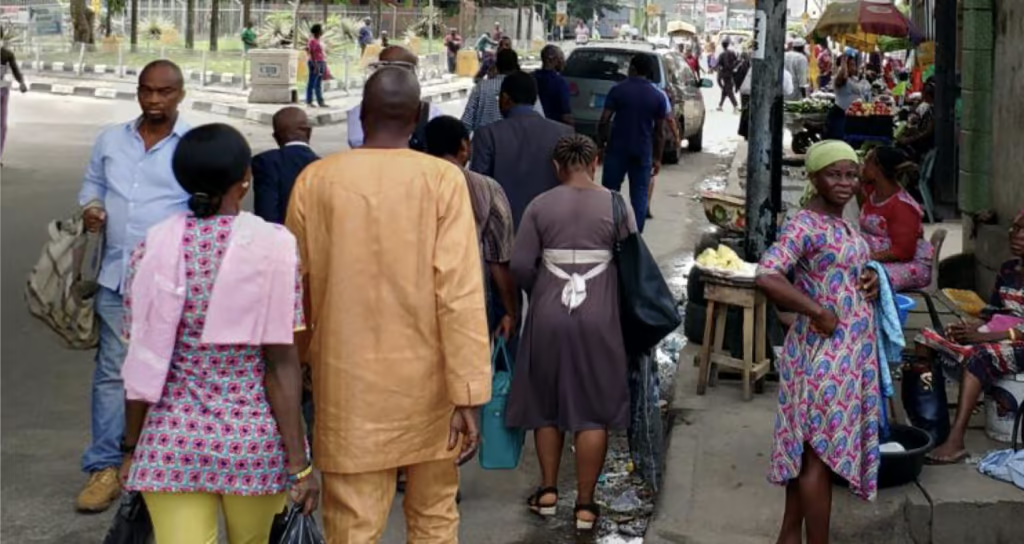
In African cities, walking is the primary mode of transport for the majority of people, with in the order of 78% of people walking for travel every day (UN Environment, 2021). People travel for an average of 55 minutes per day on foot, yet data from nine African countries shows that 74% of roads have no footpaths, 92% no crossings, and 48% are poorly signed and maintained (https://www.irap.org/3-star-or-better). Across the continent, in 2019, some 33% of all road traffic fatalities, and 35% of all daily road injuries, were people walking. The World Road Association’s (PIARC) catalogue of design safety measures estimates that investment in pedestrian facilities could reduce crashes by up to 90% (UN Environment, 2021).
People walk in African cities mostly to save on the high cost of public transport, where between 30-49% of household income might be spent on travel otherwise (Porter, Abane and Lucas, 2020). Where walking is a main mode, this dramatically limits the range within which people may access opportunities and have the needs of their daily life met. Women and children are more likely to walk than are men and therefore are more disadvantaged. Pedestrians also face a bewildering array of challenges, from flooded roads to snakes and other dangerous animals, speeding drivers, construction rubble, potholes, storm drains and raw sewers, physical attacks, and lack of shade and resting places. Often what little space they might have in which to walk is crowded in by informal traders and, at times motorcycle-taxis (boda-bodas). Although walking is regarded as a high-value public health intervention in European and US cities, in African cities the exposure to pollutants and motorised traffic renders this moot, although there are few systematic reviews of the challenge to date (Porter, Abane and Lucas, 2020; Tiwari et al., 2020). As urbanisation picks up pace, attending to the lack of pedestrian infrastructure becomes ever more challenging, because of the need to retrofit the built and the prevailing regulatory environment, but also claim a share of resources where cities are directing more toward big-infrastructure public transport reform (Vanderschuren et al., 2017).
As well as benefiting a billion people’s transport every day (UN Environment, 2021), improving walking facilities will also accelerate the delivery of existing Sustainable Development Goal (SDG) commitments to: increase health and well-being (SDG 3); reduce inequalities (SDG 10); make more inclusive, safe and resilient communities (SDG 11); and mitigate the impacts of climate change (SDG 13).