Infrastructure Toolkit for Non-Motorised User Safety in African Cities: Challenges and Solutions
Published: {acf_publication_date: F Y}
Main topic: Access and infrastructure, Cycling, Walking
Study countrie(s): Sub-Saharan Africa, Africa
Written by: Tom Bishop, Ayikai Poswayo, Juliet Adu, Ronny Charles
Published by: Amend, The FIA Foundation
Study type: Research report
This toolkit has been developed to assist engineers to design and build safe roads in Africa’s towns and cities. Across Africa, urban areas are growing rapidly, and governments, often with the support of development partners, are building new roads and upgrading existing ones.
However, the vast majority of African urban dwellers do not own a car. For these people – who include hundreds of millions of children and youth – the predominant mode of transport is walking. If these people are to benefit from urban development, they must be considered in the design of towns and cities. With the way that many urban roads are currently being designed and built, pedestrians and other non-motorised users (NMU) find themselves at particular risk. New smooth road surfaces allow for high vehicle speeds, with little designed-in segregation of non-motorised users from vehicles, and often ineffective speed control.
Pedestrian footpaths are too narrow, crossing points are incorrectly placed, speed humps lead to erratic acceleration, braking and swerving, road signs are not adhered to by drivers. As a result, a higher proportion of pedestrians die on African roads than in any other part of the world. In many countries, the design manuals that engineers follow – and the training that they receive in university – do not provide them with sufficient solutions to ensure the safety of pedestrians and other non-motorised users.
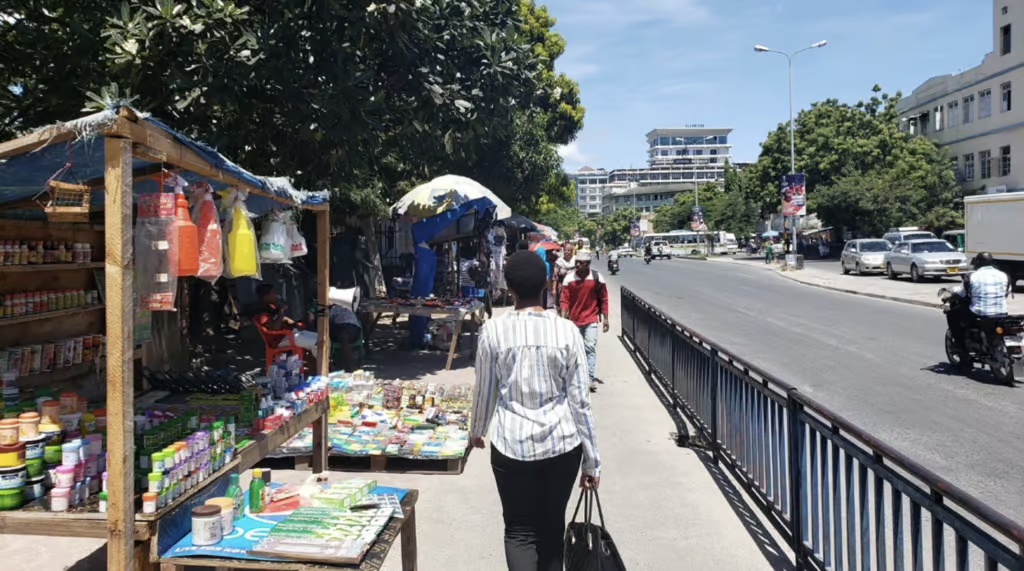
The solutions to reduce the risk of pedestrian road traffic injury are well known. There are many excellent international manuals and guidelines describing these solutions. However, they tend not to be targeted at an African audience as they do not address many of the specific challenges that engineers in African towns and cities face: motorcycle taxis riding on footpaths; climate-related difficulties with road paints; open drains; vendors blocking footpaths; the use of hand-drawn carts; and so on.
The solutions presented in this toolkit are designed to be practical, affordable and within the ability of engineers to implement. We recognise that the challenge of improving the safety of pedestrians and other non-motorised users will not be addressed by infrastructure alone. But we believe that building Africa’s roads, towns and cities safely now will have a dramatic impact on the safety and quality of life for generations to come.
This toolkit has been prepared by Amend, based on experience of working on pedestrian infrastructure improvements in more than a dozen countries in Africa, with the support of UK Aid and the High Volume Transport Applied Research Programme.