Informal Public Transport Routemap & City Comparative Analysis: Final Report
Published: {acf_publication_date: F Y}
Main topic: Access and infrastructure, Public transport
Study countrie(s): South Africa, Sub-Saharan Africa, Sierra Leone, Mozambique, Ghana
Written by: Ansumana Tarawally, Kwame Kwakwa Osei, Mamaa Grant Monney, Michael Johnson, Jeff Turner, Charles Adams, Herrie Schalekamp, JoaquÃn Romero de Tejada, Joseph Macarthy, Marion Hoyez, Mark Zuidgeest, Roger Behrens, Simon Saddier, Tim Durant
Published by: Vectos South Ltd
Study type: Research report
What happens in urban transport in African cities over the next two decades will be a key determinant in global climate change outcomes. The population of Africa doubled to 1.3 billion during the period 1990 to 2020 and is projected to increase by a further 1.2 billion by 2050. TRANSITIONS takes the view that Informal Public Transport (IPT) should (continue to) play a central role in providing sustainable, mass transit within rapidly growing metropolitan areas, and therefore a concerted effort is required to understand how stakeholders can best work together towards improvements.
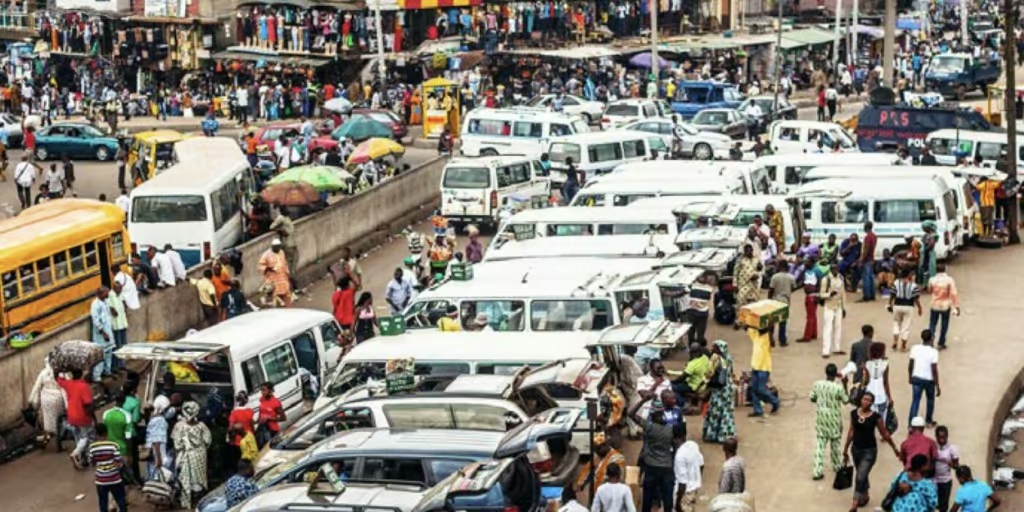
Informal Public Transport (IPT) services often provide benefits seldom associated with scheduled, mass public transport services: IPT business owners are quick to respond to new demands for service, and as a result penetrate many and diverse passenger markets within the city. As the coverage provided by formal Public Transport services is very limited for the majority of cities of Sub-Saharan Africa (SSA), millions of households depend upon IPT in part or in whole to gain access to essential activities located beyond walking distance. Given the unprecedented urbanization forecasts for Sub-Saharan Africa countries over the coming decades, and the pressures this will place on already stretched transport authority capacities and resources, the ability of IPT to respond rapidly to new patterns of demand is likely to be an important asset.
This demand-responsiveness in service provision is currently achieved free of subsidisation by public authorities.
A further important benefit of IPT services is their ability to offer a source of income generation to a segment of the population that often finds itself superfluous to the formal economy.
The benefits of IPT outlined above are, however, often accompanied by substantial problems. Most of these problems can be linked to both ease of market entry, which in some instances may be entirely self-regulated through route or driver associations, and the capacity of transport authorities to formulate and enforce coherent regulatory regimes.
This has led to an over-supply of IPT on more lucrative routes and, in the absence of effective law enforcement, to attempts to violently remove competitors and unsafe driver behaviour.
A combination of factors including fuel inefficiency of old and poorly maintained vehicles, payment of taxes and fees (together with corruption), as well as faresetting by public authorities, results in tenuous business viability for operators.
Poor viability has in turn resulted in overloading of passengers on the most popular routes, and the withdrawal of services from less lucrative routes or times of the day.
The labour conditions for vehicle crews and manner in which they are paid can also be exploitative.
Vehicles used for providing IPT are often unroadworthy, unsafe and heavy emitters of air pollutants.
Boarding and alighting practices that spill into traffic lanes and onto pavements, reduce already limited road capacities considerably and present dangers to vulnerable road users.
These externalities of IPT have resulted in a poor image and attempts by public authorities to eradicate them (through bans or forced co-option within formal PT structures).
TRANSITIONS proposes that in city contexts where IPT services typically hold the majority of the public transport modal share, this is neither pragmatic nor strategic. Even in the limited examples where alternative high-capacity formal public transport schemes have been delivered, such as the Bus Rapid Transit (BRT) services in Cape Town and Dar-esSalaam, these currently serve only a small proportion of the overall population. Whether in parallel with formal PT projects, or as an alternative approach, there is a strong case for improving, or ‘transitioning’ IPT services, their comfort, reliability, safety, and sustainability.