COVID-19 Urban transport response: Opportunities for policy-making in Africa
Published: {acf_publication_date: F Y}
Main topic: Crisis response, COVID-19
Study countrie(s): Sub-Saharan Africa, Africa
Written by: Jeff Turner, Holger Dalkmann
Published by: High Volume Transport Programme
Study type: Policy note
The urban transport sector is at the heart of the current COVID-19 pandemic – as a vital service for health and other key workers, who have to get to their workplaces.
Therefore, it is crucial to provide a coordinated, science-based response from all levels of government to maximise the best possible public health outcome with the least economically damaging impact for all.
While every country is challenged with its own specific problems, there are some common challenges for the continent, when it comes to urban transport:
– Public transport is needed to ensure movement for key workers (health, essential services, etc.) and population’s access to medical facilities and food stores.
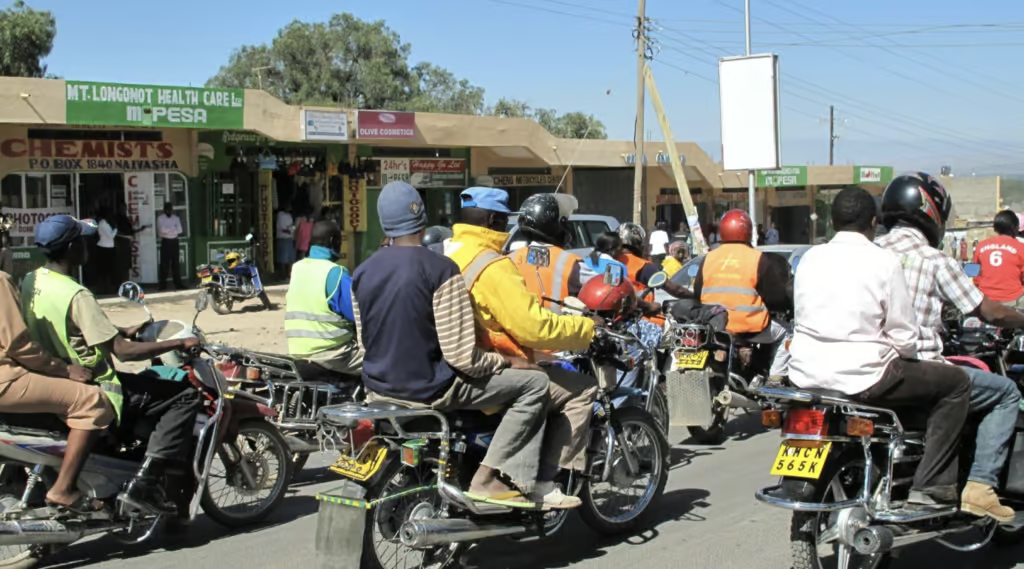
– Public transport systems feature significant use of small vehicles with limited internal space, reliant on high passenger numbers to be viable. COVID-19 may spread through transport use (high number of people in vehicles, congested terminals, no opportunity to identify sick people, variety of common surfaces).
– The fragmented nature of minibus operations and slim margins often may not allow for additional expenditures, e.g. for disinfectants and personal protective equipment.
– Operators may have incentives to compensate for lower occupancy required as part of the COVID-19 response by increasing fares for passengers.
– Public transport is part of the urban food supply chain that links traders to market and food to neighborhoods while households stay at home. In Nairobi, 97% of women surveyed reported concerns about access and affordability of food due to COVID-19 measures.
– Public transport – formal and informal – provides employment and livelihoods for many.
– Providing stimulus packages and financial support to informal public transport is challenging for public authorities because of its fragmented nature.
– Walking and cycling are currently the safest options to avoid exposure to the virus.However, there is insufficient dedicated safe road space and often no dedicated cycling infrastructure. Moreover, weak urban planning often results in long journeys for basic needs.
– The existence of very dense informal settlements, that lack basic services and amenities, may increase the spread of the virus and requires specific mobility solutions.
– Limited levels of technology penetration within the urban economy in many countries prevent people from limiting travel for work and engaging in cashless payments or money transfers.
Most information, policies and guidance that are currently available and can be defined as good practice originate from the global North and are not always applicable to the situation in African countries. This note suggests a common policy framework for national government stakeholders to consider in raising awareness and initiating a policy dialogue around solutions for the urban mobility sector. It should be acknowledged that each city and each state has to build its own specific set of policies and regulations, so national solutions are recommended.