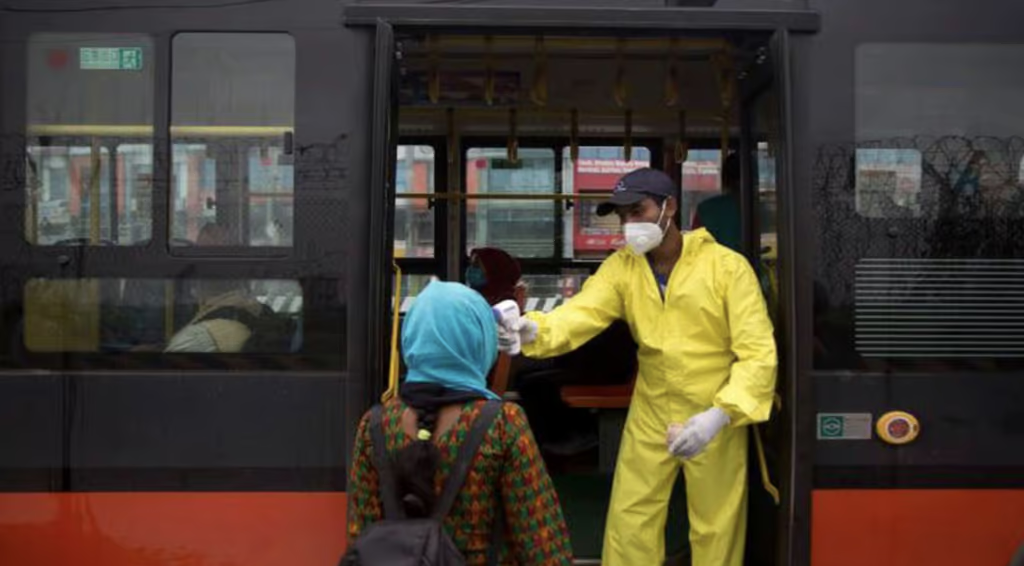
COVID-19 Impact on Public Transport and Safe Revival: Practices and Innovations
Published: {acf_publication_date: F Y}
Main topic: Crisis response, COVID-19, Public transport
Study countrie(s): Nepal
Written by: Ankit Karna, Dr. Ajay C. Lal, Dr. Jagadish C. Pokharel, Dr. Sagar Prasai, Kishore Thapa, Ranjan Bhatta, Richa Dhungana, Dr. Prastuti Sharma
Published by: Nepal Institute for Urban and Regional Studies (NIURS)
Study type: Policy note
In response to the surging COVID-19 infections, Nepal went into a complete lockdown from 24th March to 20th July 2020. Public transportation resumed service from 23rd July 2020, with limited guidelines issued by the Department of Transport Management (DOTM). But the service was halted for a second time from 20th August to 9th September 2020. From 10th September, only half the vehicles could operate as the government issued an odd-even rule, which allowed odd number plates to ply on odd dates and even number plates to ply on even dates.
Due to the two lockdowns and the odd-even rule that followed, the sector has suffered huge financial losses. Companies and owner-operators are pressured by revenue losses, loan repayments, and underutilised assets; drivers and operators have lost jobs; and the entire sector continues to suffer from a prolonged drop in commuter demand.
There are significant concerns from an epidemiological angle as well. Bus, mini-bus, micro-bus, tempo (threewheelers), taxi, and motorcycle taxis are the dominant vehicle types in Nepal. The passenger carrying capacity of buses ranges from 26 to 55 depending on its size while the capacity of micro bus, tempo, taxi and motorcycle taxi are 13, 11, 4, and 1 respectively. Each vehicle has different boarding and un-boarding systems, seat arrangements, ventilation and air-circulation systems, and length of routes. All of these factors make each vehicle represent different levels of epidemiological risks, but neither the government nor the public is aware of the relative risk exposure in choosing different types of vehicles available in the mix. This study fills that crucial gap.