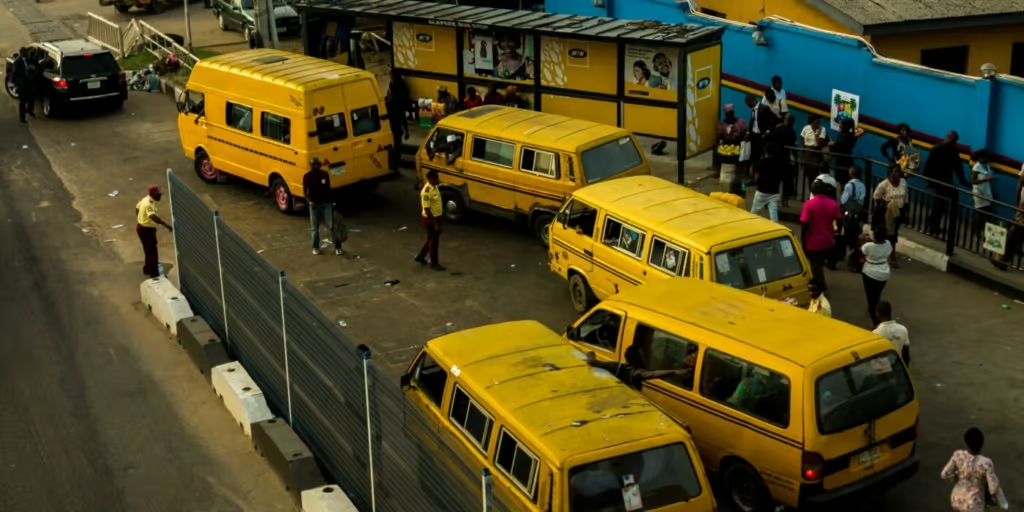
Climate Resilient Transport: A policy guide (DRAFT)
Published: {acf_publication_date: F Y}
Main topic: Access and infrastructure, Climate change, Adaptation
Study countrie(s): Global
Written by: Karen Packham, Rachel Fisher, Robin Workman, Roger Street, Sarah Greenham, Stephen Mills, Will Baxter, Clive Roberts, Kevin McPherson, Emma Feranti, John Dora
Published by: University of Birmingham
Study type: Research report
The climate is changing. Mean global surface temperature has increased since industrialisation because more greenhouse gases, such as carbon dioxide, have been released into the atmosphere as a consequence of meeting the needs of modern life. Shifts in Earth’s climate are leading to changes in temperature and precipitation, and a rise in sea levels. Extreme weather events are changing in frequency and magnitude, which can result in major damage to infrastructure that people depend on to access education, healthcare, employment and more. Even with global efforts to reduce greenhouse gas emissions, the world is already experiencing an increase in climaterelated hazards, particularly in the last decade.
Resilient transport networks that can withstand the impacts of weather and climate change are crucial in order to sustain the social and economic needs of communities. This is a particular challenge for developing countries, as losing a vital or in some cases the only transport link to essential services can exacerbate existing risks or introduce new risks associated with poverty. Moreover, low-income countries (countries with the lowest gross national income) are located in regions of the world that are already experiencing the greatest impacts of climate change, such as drought, extreme heat and storms with heavy rainfall and associated flooding.
Addressing the challenges that transport networks face in low-income countries due to climate change supports the United Nations Sustainable Development Goals (SDGs) for 2030 in both direct ways, such as making cities and human settlements inclusive, safe, resilient and sustainable, and indirect ways – for example by reducing poverty and hunger, improving access to quality education, providing decent work opportunities and fostering economic growth.
This emphasises the importance of taking steps to improve transport resilience.
This policy guide provides background and context on the problem and practical steps to develop, prepare and implement adaptation plans for transport resilience to climate change.
Its information is based on findings in a recent State of Knowledge report on Adaptation for Transport Resilience in Low-Income Countries in Africa and South Asia, and as such, it is targeted at policymakers in these regions. Nevertheless, this guidance should be useful for all those involved in transport resilience.
The need to make transport networks more resilient is urgent and is possible to do so by acting now. It begins with raising awareness and engaging fully with stakeholders on the issues, with firm commitments on action from government. Adaptation plans and strategies with strong foundations and based on good data should enable robust monitoring and evaluation processes, which in turn will support continuous investment and improvement in resilience. There is a wide range of tools and resources available to support adaptation planning for transport resilience and many of these are referred to in this policy guide.
One of the outcomes of COP26 was the Glasgow Climate Pact, which urges Parties to communicate and continue to review their pledges in reducing emissions and taking action to adapt to climate change in the format of a nationally determined contribution, or NDC. An NDC is a key document that provides a foundation for national adaptation planning.
However, to date, neither NDCs or national adaptation plans typically include much detail on the transport sector, despite its essential role for nations, societies and individuals.
Commitments from all those engaged in and affected by transport matters – from policymakers and transport authorities to businesses and civil society can and should make a difference in developing more resilient transport networks for the benefit of their users.